Life-long Learners with Eternal Purpose
Pneuma Christian School, Lakeland, Florida
A first look at the Pneuma Mastery Platform
A working proof of concept, built for 10th grade World History. Students work through a unit one skill at a time, inside a daily online limit of about two hours. A tutor helps without handing over answers. Guides on campus run the labs and seminars, hear every oral defense, and step in when a student is stuck.
The live demo opens the real app with a sign in list of fictional students, parents and guides. Pick anyone to see the platform as they would. Nothing in it is real student data.
About three minutes. Every screen in the video comes from the running app. The students, parents and guides shown are fictional. Download the video.
The problem
One teacher. Twenty or more students in the room.
Every one of them needs something different. They come from different homes and learn in different ways, and last year went differently for each of them.
- Strong students wait for the class to catch up.
- Others need help the teacher has no time to give.
- Written work can sit for weeks before anyone grades it.
Pneuma is not trying to replace its teachers. The school wants to free them to be coaches, so they can encourage and disciple each student while the software carries the individual instruction and the testing for mastery.
The model
Mastery, not seat time
The 2 hour learning model, with Pneuma's faith laid through it. Every part of the platform serves one half of the school's mission or the other: a love of learning, and a passion for following Jesus.
The school's leadership has said that many families who share Pneuma's worldview want a school where their children are kept safe, grow in holiness and are filled with the Holy Spirit. The platform is built to serve that school.
About 2 hours online
The school has promised parents this, and the platform keeps to it. Four core subjects get about 25 minutes each. The rest of the day is books, labs, seminars and people.
A skill graph
A unit is a set of small skills. Each one opens when the skills before it are mastered. A placement check first lets a student skip what they already know.
90% before moving on
Students move on when they understand. The end of the week does not decide it. Below 90% is "not yet", with a clear next step and some hole filling on earlier skills.
Guides on campus
Teachers become guides. They open labs and seminars in prayer, run the campus hook, hear each oral defense in person, and step in when a student is stuck twice.
Faith that does real work
History is taught as creation, fall and redemption, with honest history that names sin in the church. A verse tacked on at the end of a lesson is not the goal.
A Hybrid High School day
7:45 to 2:00 on campus. Online time sits inside the day, never on top of it.
- 7:45 to 8:00Arrival. Devotion and prayer with the guide.
- Morning blocksFour online blocks of about 25 minutes, one per core subject. The skill graph picks up where each student left off.
- Between blocksReading physical books, Socratic seminar, discipleship, chapel on the school's chapel days, lunch and time with friends.
- 1:30Lab or workshop with the guide. Opened in prayer, built on a campus hook broad enough to fit wherever each student is in the unit. The 30,000 foot view of the subject.
- 2:00Dismissal.
The times inside the day are a proposal for the school to adjust. Arrival, tardy and dismissal come from the handbook.
The Pillars of a Pneuma Graduate
Who is this student becoming?
The handbook asks that question every bit as much as "what is this student learning?" Each pillar shows up somewhere real in the platform.
Wise
"Study to shew thyself approved unto God, a workman that needeth not to be ashamed, rightly dividing the word of truth."
2 Timothy 2:15
Students read real primary sources and test claims against them, the way they are taught to handle the Word.
Articulate
"Be ready always to give an answer to every man that asketh you a reason of the hope that is in you with meekness and fear."
1 Peter 3:15
Each unit ends in an oral defense on campus. A guide hears the argument live and scores it.
Diligent
"The soul of the sluggard desireth, and hath nothing: but the soul of the diligent shall be made fat."
Proverbs 13:4
"Not yet" means try again with a next step. No streaks, no leaderboards. Perseverance is noticed by people.
Humble
"Whosoever will be great among you, let him be your minister; and whosoever will be chief among you, let him be your servant: even as the Son of man came not to be ministered unto, but to minister, and to give his life a ransom for many."
Matthew 20:26 to 28
The Reformation unit asks students to lament the sins of their own side, not only the other.
Our prayer is that every graduate will leave Pneuma Christian School equipped academically, grounded biblically, confident in their identity in Jesus, and prepared to faithfully influence their homes, churches, communities, and the world.
Verses are quoted from the King James Version, the translation the tutor uses.
AI, used for good
A tool for building the kingdom, kept inside the school's faith
The school's leadership sees AI as a tool that will be used for good and for harm, and wants Pneuma's students to learn to use it for things that build the kingdom.
What the AI does
- Adapts each student's path. A placement check skips what they know, a slower path adds sources and worked examples, and spaced review brings a skill back just before it would be forgotten.
- Tutors without giving answers. It asks a question back, then gives a hint, then hands the student to a guide.
- Gives a first estimate on written work, so students hear back in minutes instead of weeks.
- Helps the school's own authors draft skill cards from the school's own documents.
What keeps it safe
- The rubric gate. No unit reaches students until a named reviewer scores it against the school's six domain design rubric.
- Faith rules. Every tutor reply follows the school's statement of faith. The tutor never speaks doctrine on its own, and pastoral questions go to a person.
- Safeguarding. If a message suggests a student may be at risk, staff are alerted. A person makes any report.
- Guide review. Every AI score waits for a guide to confirm or change it.
- The cap log. Online minutes are logged for every student, every day, and the daily cap holds.
The platform today
What a student, a guide and a parent see
Screenshots from the proof of concept with demo data. Click any one to see it full size, or open the live demo and click through it yourself.
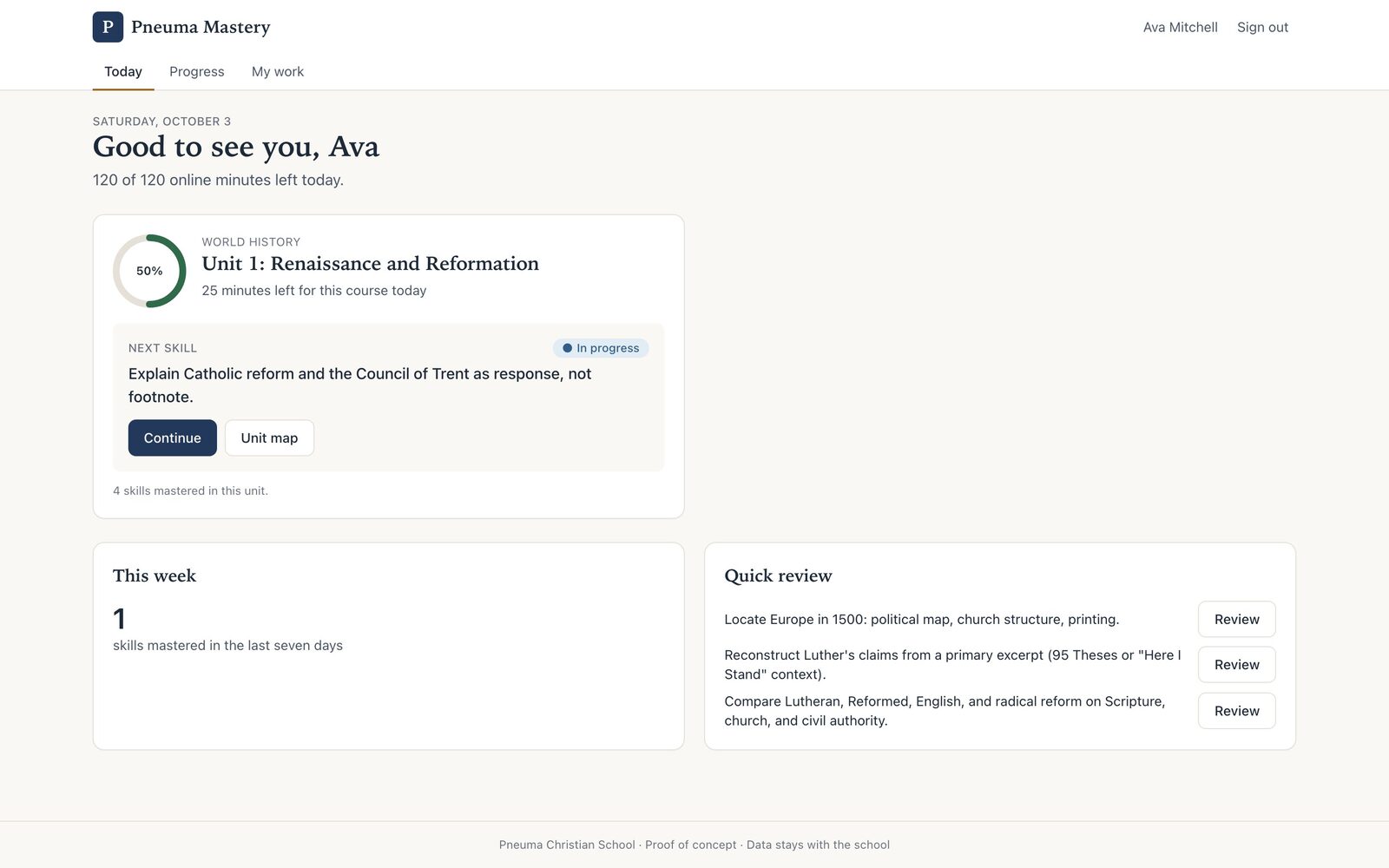
Today
Ava starts her day. She sees her next skill and how many online minutes she has left.
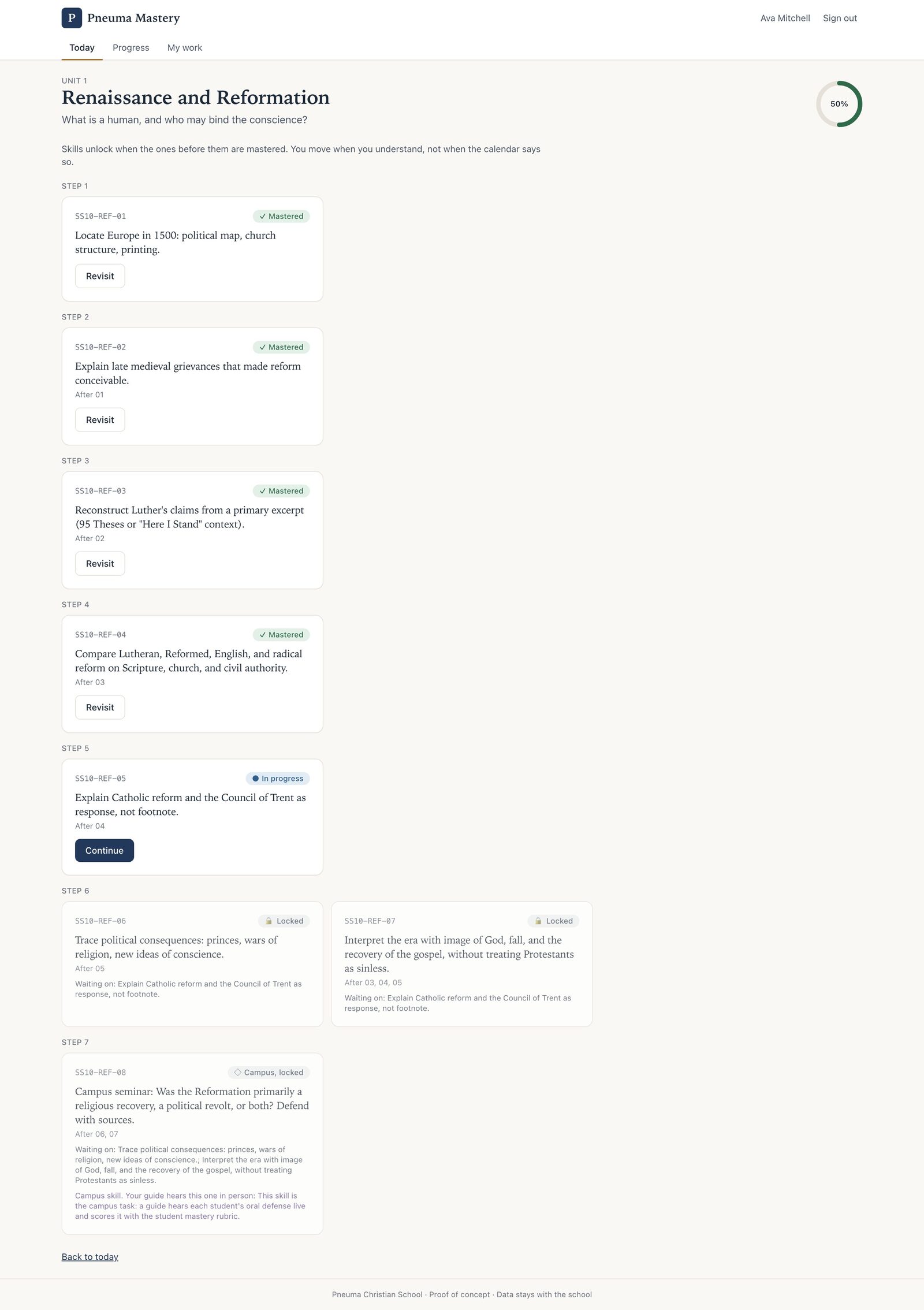
The unit map
The unit is a skill graph. Ava has mastered three skills and is working on the fourth. The rest open when she is ready.
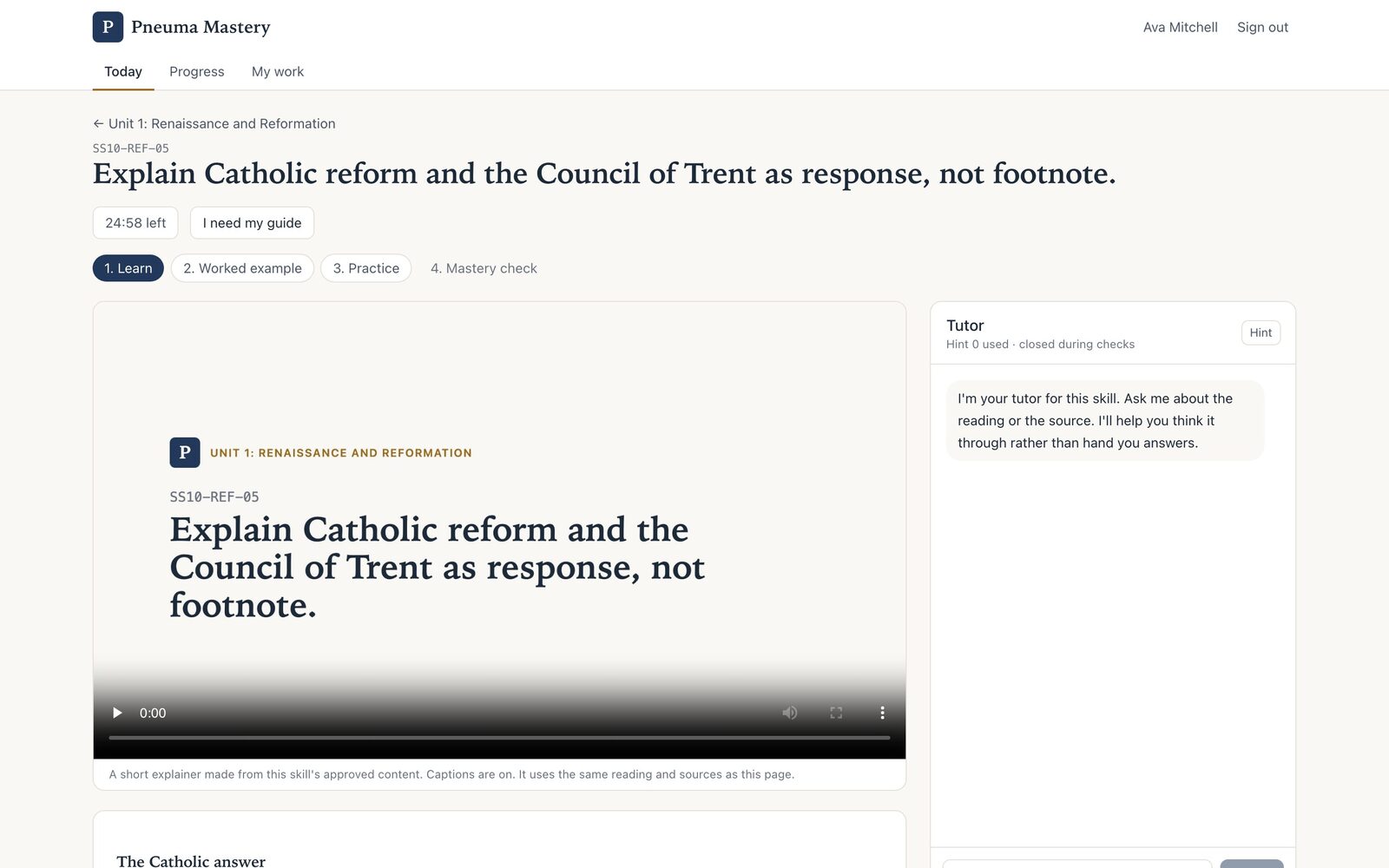
Learn
Each session starts with a short video and a reading, built on primary sources the school has approved.
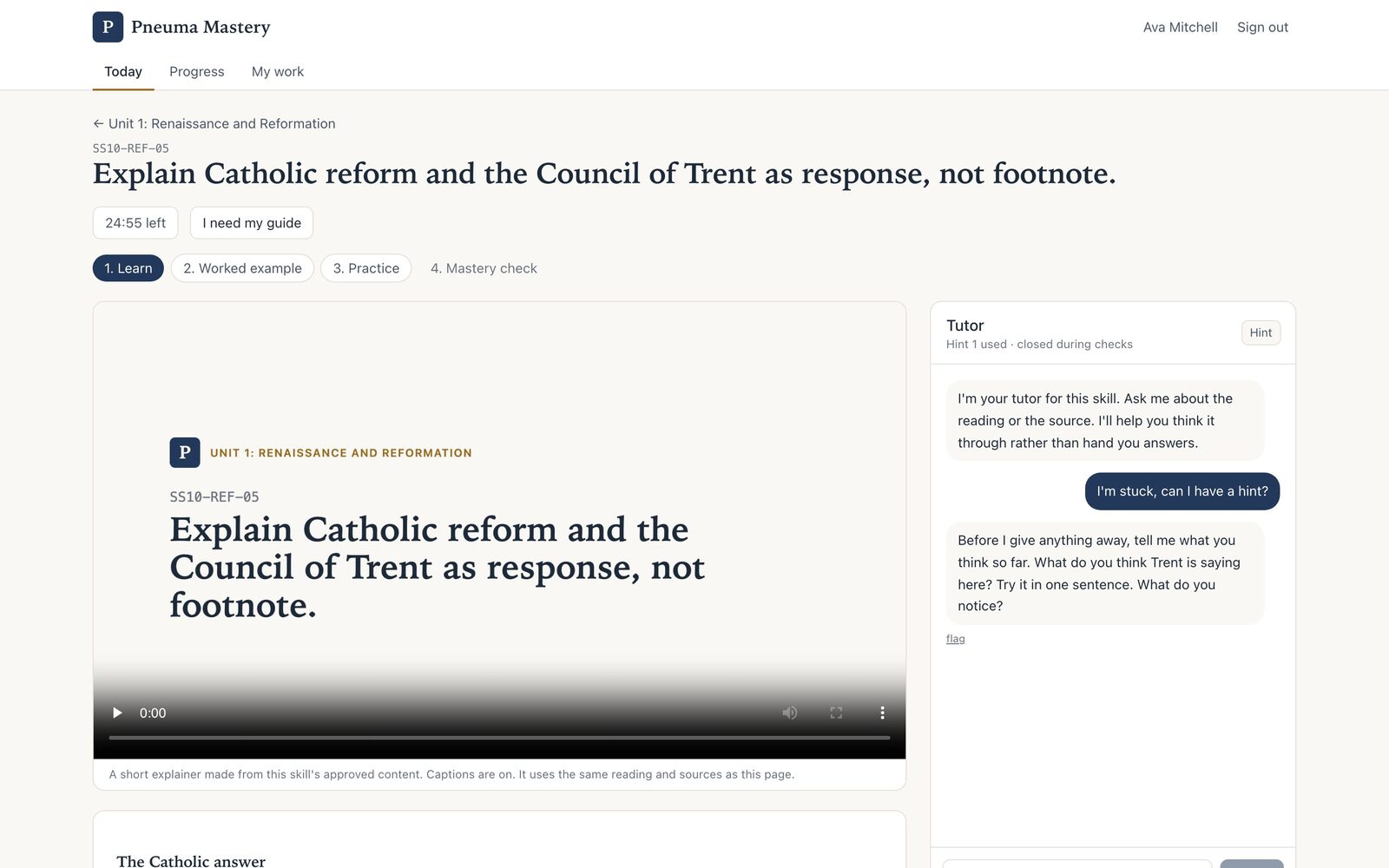
The tutor
When she is stuck, the tutor asks her a question back. It gives hints, not answers.
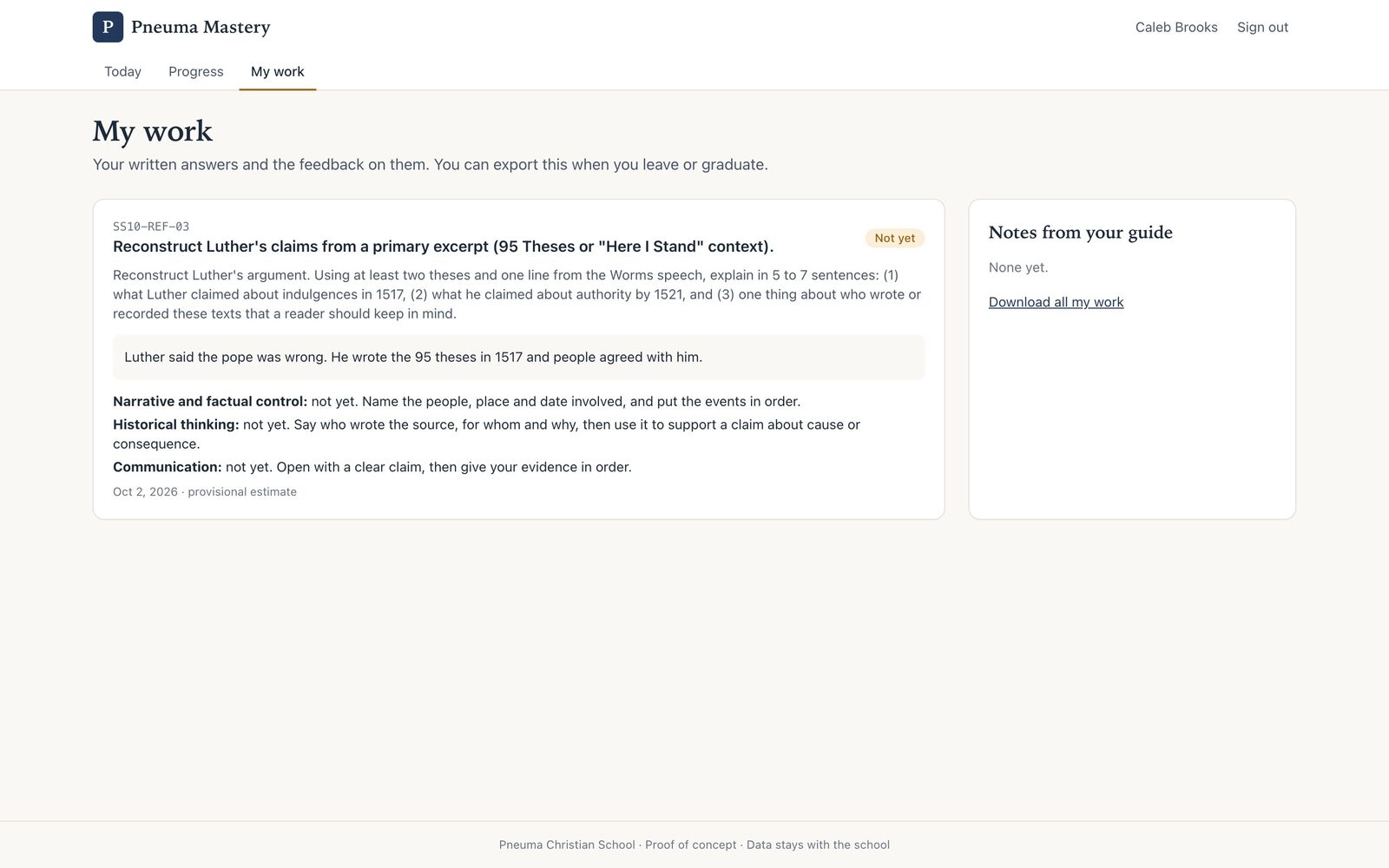
Mastery check
A mastery check gives feedback on each part of the rubric. Not yet means try again, with a clear next step. Every AI score is provisional until a guide confirms it.
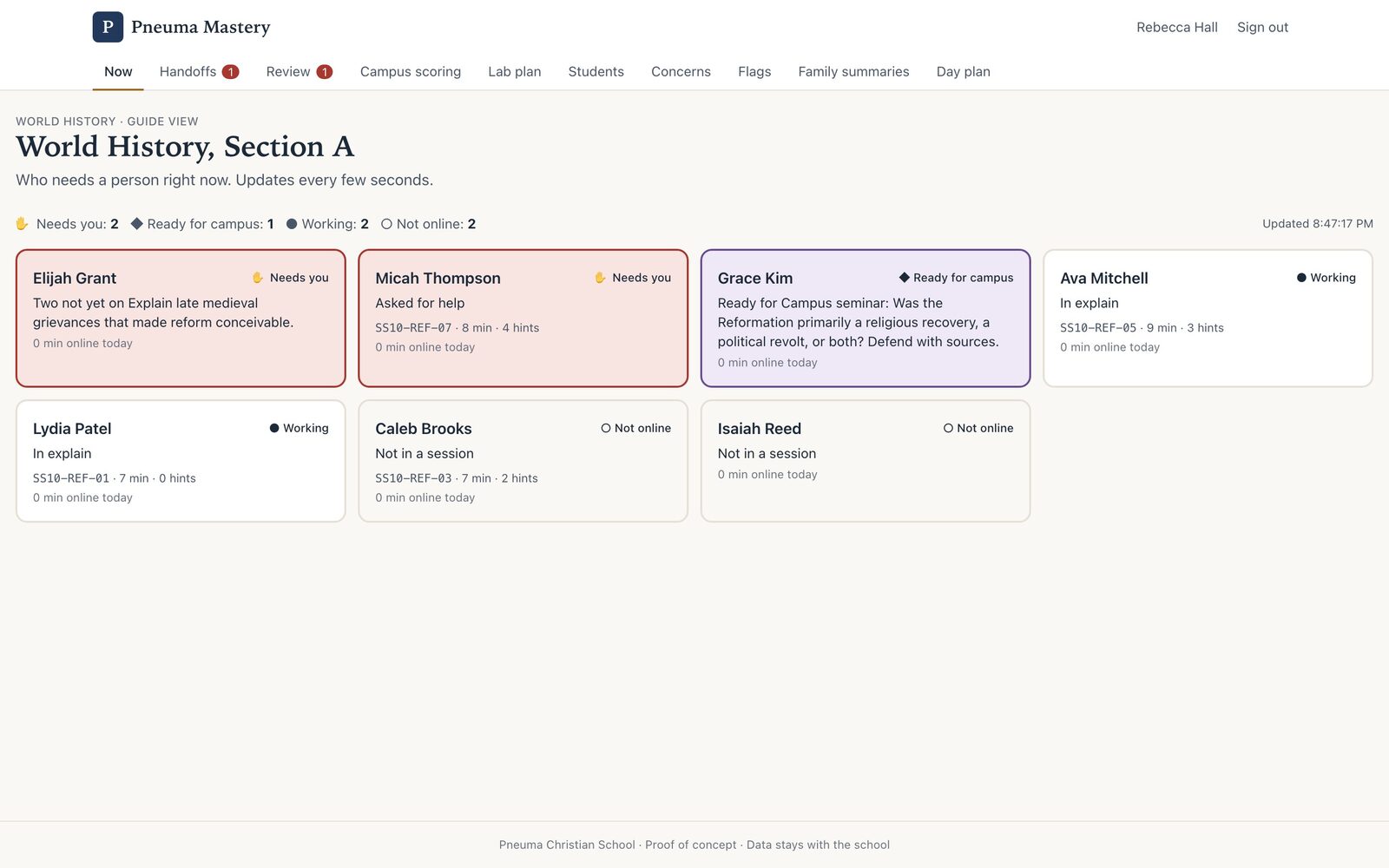
Live view
Her guide sees the whole section at a glance, and who needs a person right now.
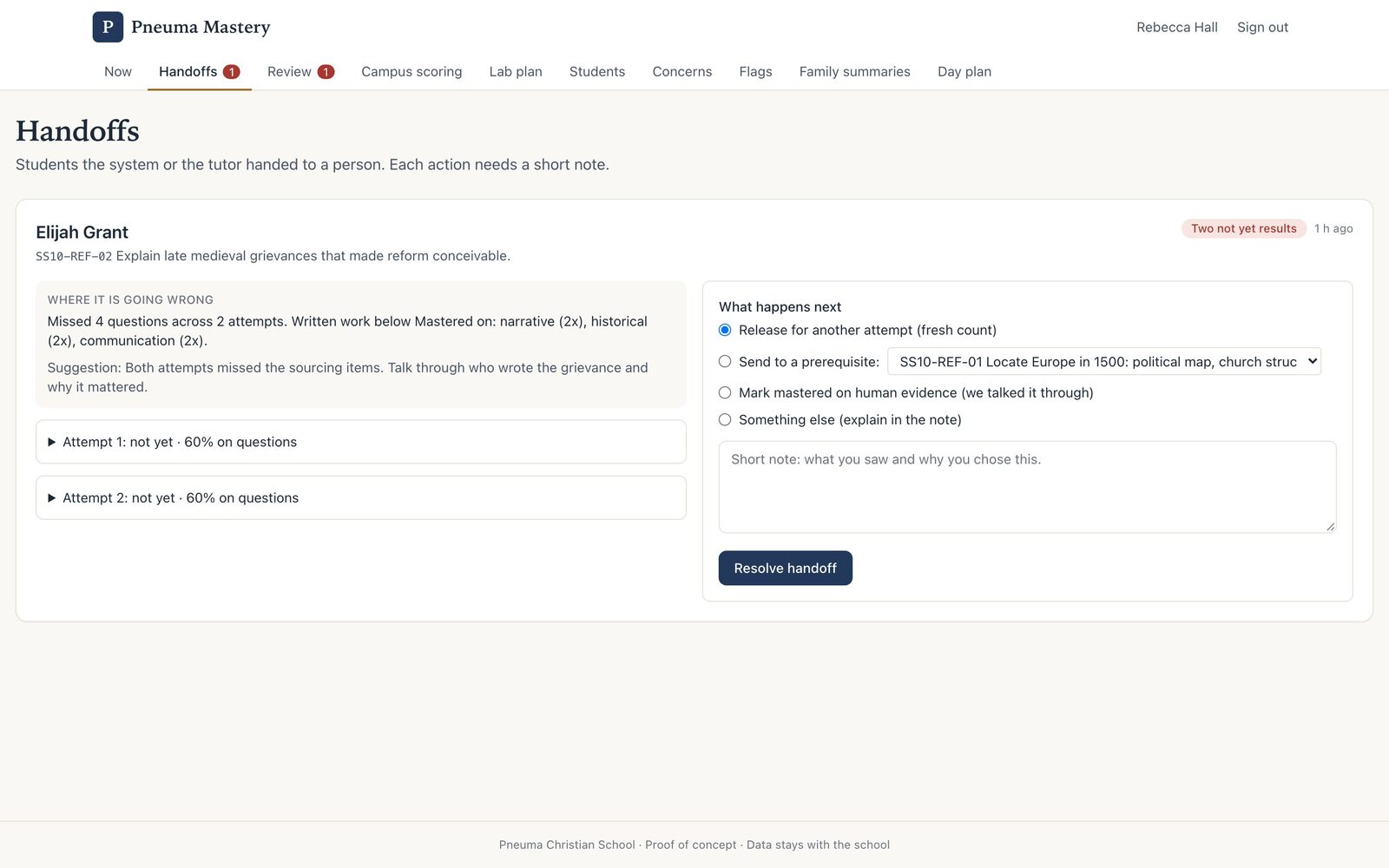
Handoffs
After two not yet results the platform hands the student to the guide, with notes on what is going wrong.
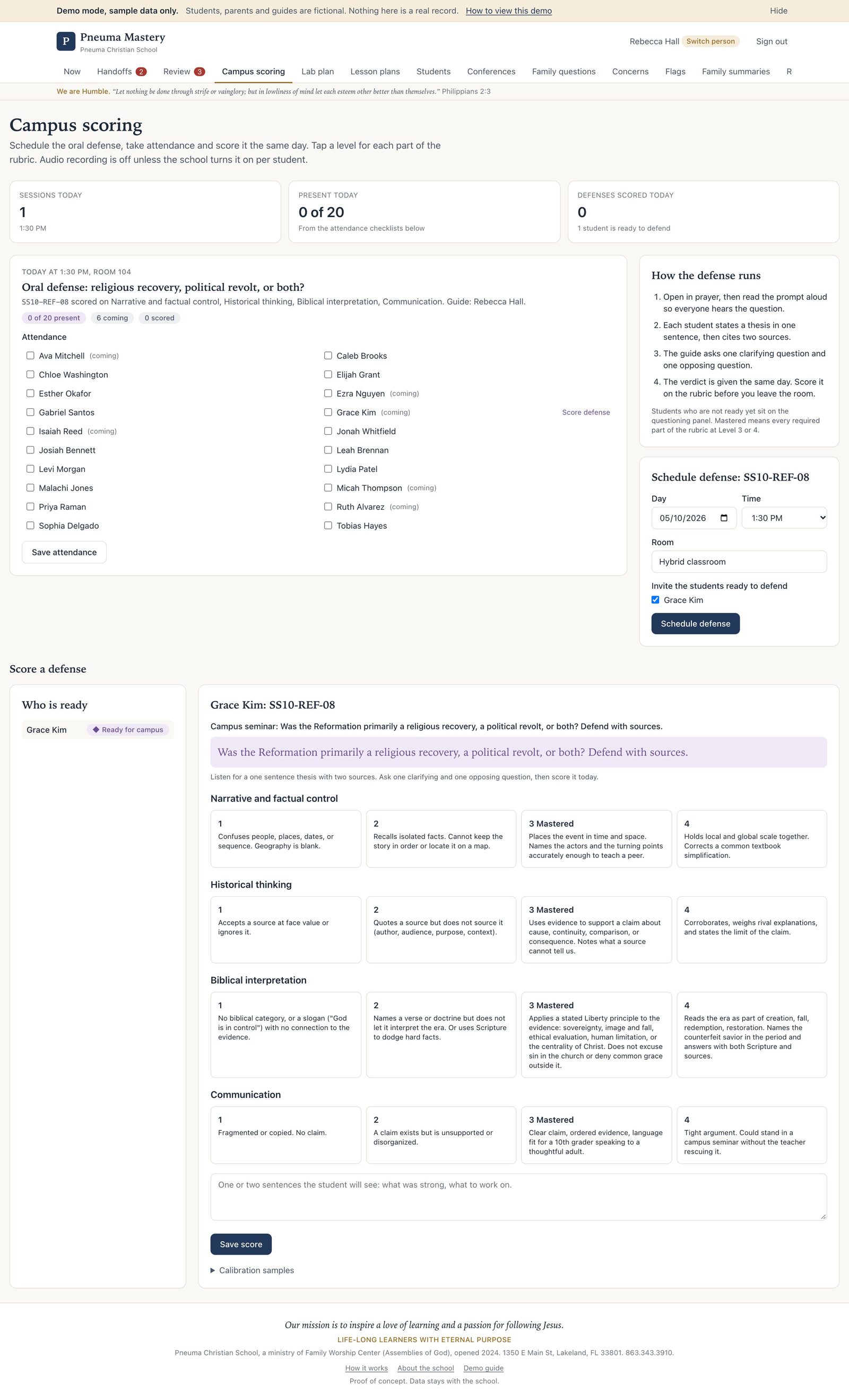
The oral defense
The unit ends on campus. Grace defends a claim about the Reformation from the sources, and her guide scores each part of the rubric live. No audio is kept.
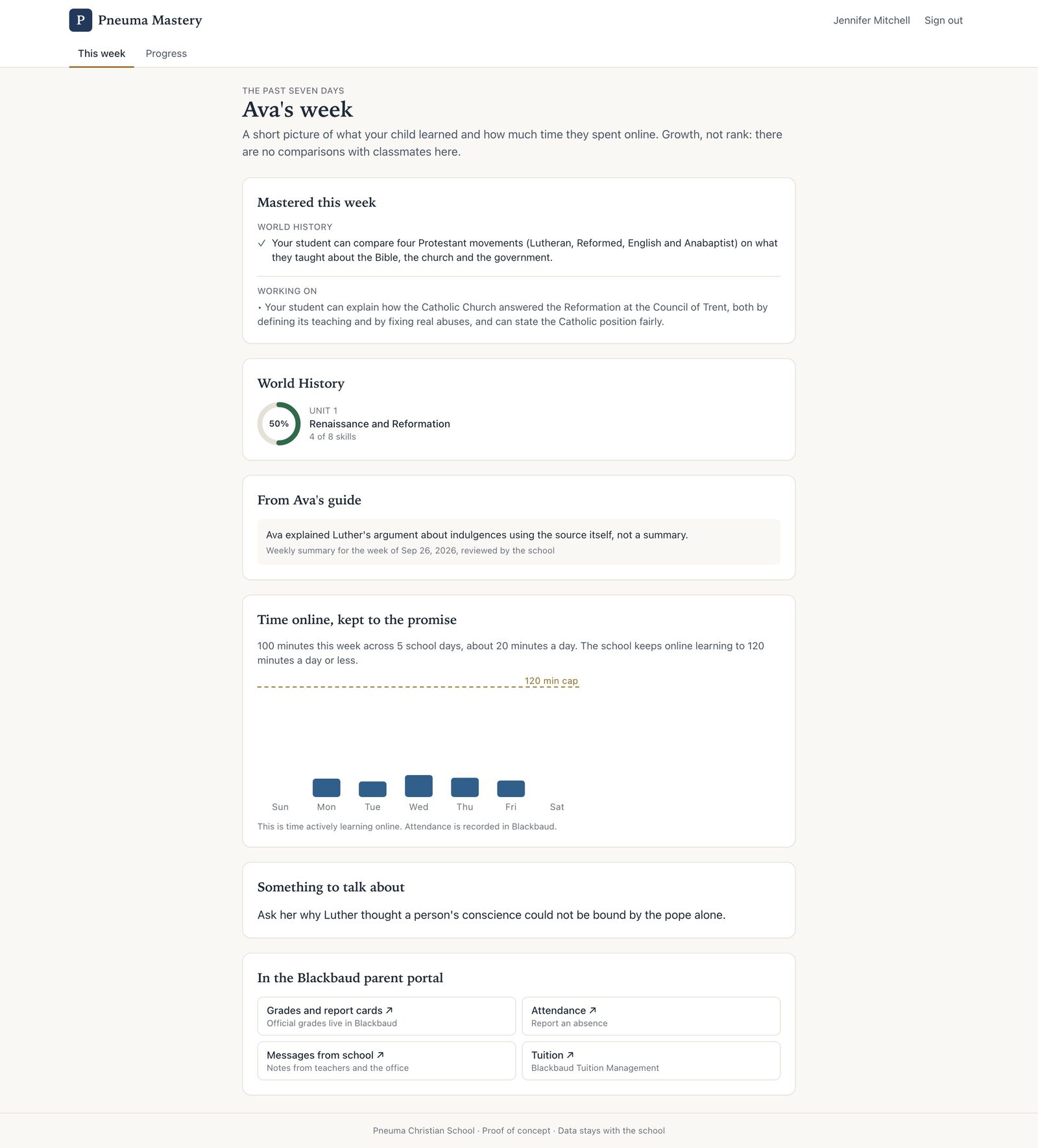
The weekly picture
Parents get a short weekly picture: what was mastered, a note from the guide, and time online kept under the cap. Growth to celebrate, not a list of missing assignments.
For families
Why a school that loves books uses a screen at all
Many families who choose Pneuma love classical learning and a literature heavy education, and they are rightly wary of children on screens all day. So are we. The screen is there for one job: individual instruction and testing for mastery in the core subjects, done well and done quickly.
That job takes about two hours a day, and the platform will not let it take more. A student is on campus about seven hours. That leaves five for physical books, Socratic seminars, hands on labs and experiments, chapel, discipleship and time with people who know them.
Parents see their child's growth each week: skills mastered, a note from the guide and minutes online. They do not get a feed of every click. At this age students learn to take ownership of their education, and the school wants to help that happen.
Known, loved, protected
People stay responsible for every student
Guides confirm grades
An AI score on written work is only a first estimate. A guide confirms or changes every level.
Units are reviewed
Every unit is scored against the school's design rubric by a named reviewer before students see it. The audit log records who submitted it and who decided.
Safeguarding alerts
If a message to the tutor suggests a student may be at risk, staff are alerted. A person makes any report.
Parents consent
Each guardian gives or withholds consent for things like voice and media. In a split family each parent has their own say.
The cap holds
Online minutes are logged every day. Families and the accreditor can see the two hour promise kept.
No audio stored
Oral defenses are heard live by a guide. No audio is recorded unless the school turns it on for a student.
Unit 1: Renaissance and Reformation
Skill explainers
One short video for each online skill in the first unit. They are made only from content the school has approved, and every quotation is checked word for word against its source.
SS10-REF-01
Locate Europe in 1500: political map, church structure, printing.
SS10-REF-02
Explain late medieval grievances that made reform conceivable.
SS10-REF-03
Reconstruct Luther's claims from a primary excerpt (95 Theses or "Here I Stand" context).
SS10-REF-04
Compare Lutheran, Reformed, English, and radical reform on Scripture, church, and civil authority.
SS10-REF-05
Explain Catholic reform and the Council of Trent as response, not footnote.
SS10-REF-06
Trace political consequences: princes, wars of religion, new ideas of conscience.
SS10-REF-07
Interpret the era with image of God, fall, and the recovery of the gospel, without treating Protestants as sinless.
Why giving matters
Every gift advances a Gospel-centered education
Pneuma Christian School is a ministry of Family Worship Center. It was born from the church's vision to make disciples and invest in the next generation, and it was built through the prayer, generosity and faithful service of that community. The school exists so that students are known, loved, challenged, and formed for Kingdom purpose.
This platform is how a small, young school gives every high school student a path fitted to them, without asking one teacher to be everything to twenty children at once. The engine is proven on one unit. What remains is the work that takes people and time: writing the school's own courses, training guides as coaches, and running a careful pilot before families are asked to commit.
Gifts made now pay for that work. They let the school build something it owns, in its own words and its own faith, instead of renting someone else's curriculum. If you would like to talk about supporting it, please contact the school office and ask for Abigail Scarborough, Head of Schools.
For school leadership and the board
Scope, timeline and cost
The comparison, the plan and the cost. Nothing below commits a budget. The budget is the board's decision.
How this compares to Alpha School
The same engine ideas, with Pneuma's worldview and Pneuma's content
The school looked at using Alpha School directly and found it could not put its own content or its worldview into it. So this is a custom build. It takes what is good about that system and lays the school's worldview over it.
What is the same
- A skill graph for each unit, with progress students can see.
- A 90% gate before moving on.
- Placement first, so students skip what they already know.
- 25 minute online blocks, about two hours a day on screens.
- An AI tutor that adapts to each student.
- Adults who coach instead of lecture.
What is Pneuma's
- A Christian worldview that does real work in every unit, gated by the six domain rubric and the nine Liberty principles.
- The school's own content. Pneuma authors its own core courses in the Curriculum Studio, a more rigorous replacement for the Flex and LUOA portals families use today. Every source is checked and licensed.
- Guides as required campus evidence. A skill like the Reformation oral defense can only be mastered in front of a guide.
- No webcams and no XP points. Growth is shown honestly, measured by the school.
An original build. It contains no Alpha School code or content, and no LUOA or other vendor text. The Reformation unit was written for Pneuma: original school writing plus public domain primary sources, each with its license recorded.
Timeline
From proof of concept to the first day of school
November to December 2026
Proof of concept demo
The Reformation unit end to end, this page and the video. Ready around the holidays and for the accreditation visit in November.
January to May 2027
Pilot
10 to 15 students from Hybrid High School families and a guide, on campus. Weekly check ins. We measure mastery, minutes online, authoring hours and AI cost.
Spring 2027
Advertise to families
Once the pilot shows it works, the school explains the model to incoming families. That takes time, so it starts in the spring.
August 2027
Launch
Students on the platform for the 2027 to 2028 school year. Guides trained. Families briefed.
Is August 2027 feasible?
Yes. The software is a few months of work for a small team. Most of the time goes into content: four core courses at about ten units each comes to somewhere between 240 and 480 skill cards, and every unit passes the principal's review. The plan runs content, platform, integrations and people side by side, with a funding decision for the full build by March 2027. The pilot measures how long one unit takes to author and review, which sets the pace. Each course can launch with its first units ready and keep growing through the year, several weeks ahead of the fastest students.
Roadmap
What the proof of concept has, and what the full build adds
| Area | Proof of concept (now) | Full build (by August 2027) |
|---|---|---|
| Courses | World History 2109310, Unit 1 Renaissance and Reformation, 8 skills | Four core courses for the Hybrid High School, the first units of each ready at launch |
| Students | Fictional demo students | About 30 Hybrid High School students in 2027 to 2028 |
| Student app | Today, unit map, sessions, tutor, mastery checks, "not yet" loop | Same, tuned from pilot feedback, with every course on it |
| Guides | Live view, handoffs, review queue, campus scoring, lab plan | Same, plus training for every guide |
| Families | Weekly picture with demo data | Live for every family, with real weekly summaries by email |
| Studio | Knowledge base, sources, AI drafting, design review | Same, with help to make review faster for the principal |
| Blackbaud | Grades exported as a file for Blackbaud | Roster read from Blackbaud. Blackbaud stays the system of record |
| Sign in | Open demo list | School Google accounts for students and staff, email links for parents |
| Hosting | Free plans | Managed database with point in time recovery |
Four tracks, run side by side
Content
Chris McDaniel and the authors write units in the Studio. Lindsey McDowell reviews each against the rubric.
Platform
The vTECH io project team builds and hardens the app from what the pilot teaches.
Integrations
Blackbaud roster, Google sign in, MAP Growth scores. Each kept small so nothing fights Blackbaud.
People
Guides trained as coaches. Families briefed. The donor campaign, led by Abigail Scarborough, Head of Schools.
What it costs
The full build is priced from what the pilot measures, in a written proposal in February to March 2027. Until then these are the ranges we can stand behind.
| Item | Range | Where it comes from |
|---|---|---|
| Full build | Given as a range in the February to March 2027 proposal | Authoring hours per unit and AI cost per student, measured in the pilot |
| Hosting | $10 to $60 a month | A single server or a managed database starter plan at the school's size |
| AI use | About $0.10 to $0.30 per student per school day, or $18 to $54 a year over 180 days | An estimate from current model prices. The pilot measures the real number |
| Technology fee | $25 to $50 per student. For 30 students, $750 to $1,500 each year it is charged | Raised in the July meeting as a fee parents would accept |
Ways to pay for it
Gifts
Donors who share the school's worldview fund the build, starting from this demo and the pilot results.
Spread over 4 to 5 years
The build is paid monthly as an operating expense instead of one capital outlay. That frees the money early to finish the build while fundraising continues.
A technology fee
A $25 to $50 per student fee gives a small recurring chargeback. It is about the size of one student's AI use for a year.
A mix
Most likely some of each. The proposal will show how the options combine.
Total cost of ownership, beside Blackbaud and Raiser's Edge
The school went live with Blackbaud in July 2026 and families pay tuition through it. The plan is to run alongside it, not disrupt it, and compare costs in Phase 2.
| Pneuma Mastery | Blackbaud Student Information System | Raiser's Edge NXT | |
|---|---|---|---|
| What it does | Mastery learning, tutor, guide console, family view, curriculum authoring | Enrollment, tuition, grades, records. In use now | Donor and fundraising management. Not in use |
| How it is paid | One time build, then hosting and AI use | Yearly subscription | Yearly subscription, priced by quote |
| Cost over time | Small and measured: hosting plus AI per student | Rises with the subscription each year | Rises with records and users |
| Who owns it | The school owns the code, the content and the data | Licensed | Licensed |
| The question for Phase 2 | Build cost against the yearly fees the platform could replace, and the payback period. Only the parts the school is not using well in Blackbaud are candidates. | ||
The budget is the board's decision. Every figure on this page is a range or an estimate to inform it, not a commitment.
Five questions
The answers on one page
What does it do?
Students master core subjects one skill at a time, about two hours a day online, with a tutor that will not hand out answers. Guides coach, run labs and seminars, and hear every oral defense. The school writes its own courses and reviews every unit before students see it.
From the July 2026 strategy meeting and the accreditation email on the two hour limit.
Who uses it?
Hybrid High School students in grades 9 to 12, their guides, their parents, the principal and curriculum authors, and the office. Elementary stays semi traditional.
From the July 2026 strategy meeting.
What does it cost?
The proof of concept runs on free plans. The full build comes as a range in February to March 2027, with running costs of about $10 to $60 a month for hosting plus AI use per student. The budget is the board's decision.
From the July 2026 strategy meeting and the cost section above.
When does it ship?
Demo by the holidays in 2026, pilot January to May 2027, families told in spring 2027, students on it in August 2027.
From the July 2026 strategy meeting.
How is it safe?
The rubric gate, the faith rules, safeguarding alerts, a guide confirming every AI score, parent consent, the daily cap log and an audit log of every decision. People stay responsible for every student.
From the staff handbook, the student handbook and the curriculum mastery rubric.
Phase 2
What comes after the first build
Planned for Phase 2
- Writing grades straight into Blackbaud. Today grades go across as a file.
- Payments, including the technology fee. Tuition stays in Blackbaud.
- Bringing in Hillsdale College K-12 material, once its terms are checked.
- A MAP Growth deep link and import.
- Florida test prep, and SAT, ACT and PERT readiness.
- The live voice tutor. It is already built and ready to switch on.
- Honors World History (2109320) and further courses and grades.
Florida assessments
Florida assessments (FAST, B.E.S.T. writing, US History and Civics EOCs) stay with the school; World History has no state EOC. Test prep and SAT, ACT, PERT readiness come in Phase 2.
Families who come from homeschooling know these names, so the platform will not claim a 10th grade World History end of course exam that Florida does not give.
Documents
Everything in one place
The project's single source of truth is the school's SharePoint folder (PneumaChristianSchool, Shared Documents). The deliverables below are filed there too. Ask the school office if you need access.
- The live demoThe running app with fictional people. Sign in as a student, guide, parent or leader.
- The demo videoAbout three minutes, with captions. Free to show at events.
- Seven skill explainersOne for each online skill in the Reformation unit.
- Product requirementsWhat the platform must do, with the school source for each requirement. Filed in SharePoint.
- Design review of Unit 1The rubric scores and conditions for the Reformation unit. Printable from the Studio in the live demo.
- Full build proposalCost and timeline, February to March 2027, after the pilot.